
Introduction
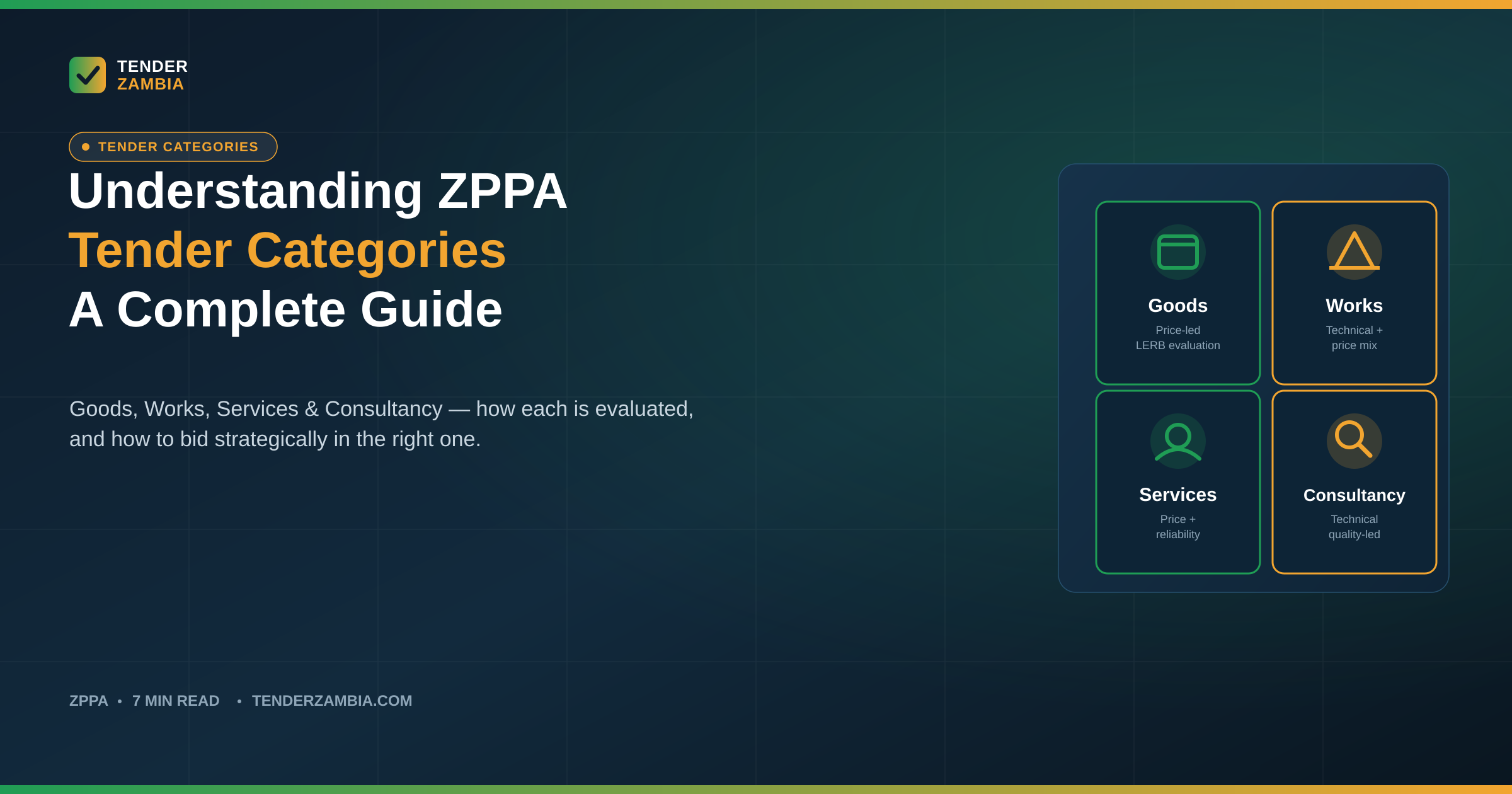
Not all tenders are created equal. The category you bid under determines your competition, your document requirements, your evaluation criteria, and ultimately your chances of winning. In Zambia, the Zambia Public Procurement Authority (ZPPA) classifies all public procurement into four main categories. Bidding in the wrong category — or misunderstanding how your category is evaluated — is one of the fastest ways to waste time and money.
This guide explains each ZPPA tender category in detail: what it covers, who should bid, how bids are evaluated, and what documents you typically need. Whether you are a construction firm, a goods supplier, a service provider, or a consultancy, this article will help you bid smarter.
The Four Main ZPPA Tender Categories
1. Goods
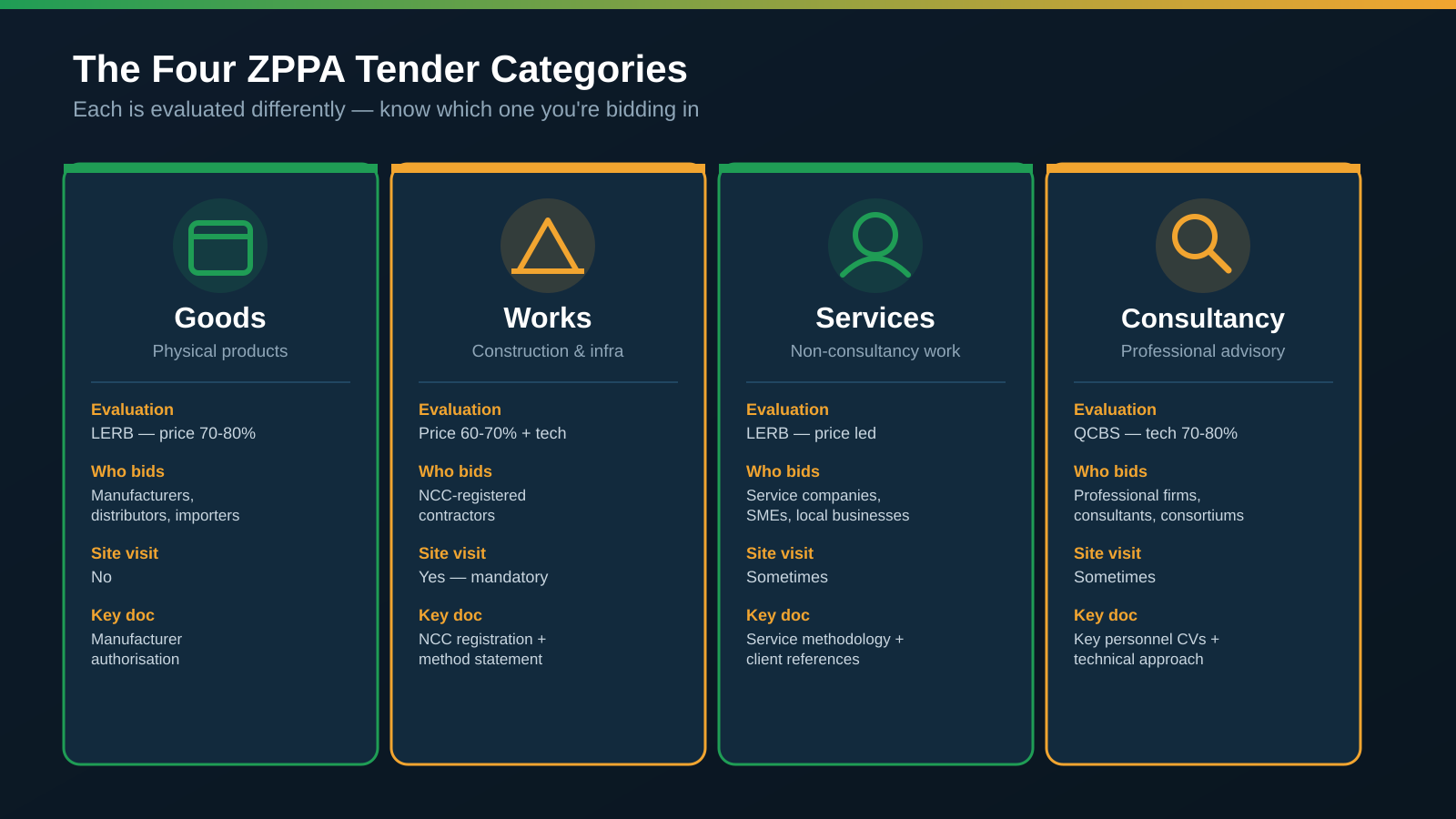
Definition: Physical products — anything tangible that a procuring entity needs to purchase. This includes office stationery, vehicles, medical equipment, laboratory chemicals, agricultural inputs, IT hardware, and construction materials.
Who bids: Manufacturers, authorised distributors, importers, and trading companies. If you sell a physical product, this is your category.
Typical value thresholds: Goods tenders range from small purchases below K500,000 (often handled via Request for Quotation) to multi-million Kwacha supply contracts for ministries and hospitals.
Example tender: “Supply and delivery of 500 hospital beds with mattresses to the Ministry of Health, Lusaka Province.”
Evaluation method: Usually Lowest Evaluated Responsive Bid (LERB). Price carries the heaviest weight — typically 70 to 80 percent of the total score. The lowest compliant bidder wins, provided they meet all technical requirements.
Key documents: PACRA certificate, tax clearance, TPIN, bid bond (for high-value tenders), manufacturer’s authorisation (if you are a distributor), delivery schedule, and product specifications.
2. Works / Construction
Definition: Infrastructure, building, civil engineering, renovation, and maintenance projects. This is the category for roads, bridges, schools, hospitals, water systems, and office buildings.
Who bids: Registered construction firms, engineering contractors, and joint ventures. In Zambia, works tenders often require National Council for Construction (NCC) registration.
Typical value thresholds: Works tenders are usually high-value — from K1 million to hundreds of millions for major infrastructure projects.
Example tender: “Construction of a 5-kilometre rural access road in Eastern Province, including drainage structures.”
Evaluation method: Usually LERB, but with a heavier technical component than goods. Works tenders require method statements, site visit reports, and equipment lists. Price might account for 60 to 70 percent, with technical competence making up the rest.
Key documents: NCC registration, performance bond capability, method statement, work programme (Gantt chart), equipment list, personnel CVs, past project references, and site visit attendance proof.
Important: Works tenders almost always require a site visit. If you do not attend, your bid may be disqualified regardless of how good your documents are.
3. Services
Definition: Non-consultancy services — anything that is not a physical product and not professional advisory. This includes cleaning services, security services, catering, event management, vehicle maintenance, and transport.
Who bids: Service companies, SMEs, and local businesses. The barrier to entry is lower than works or consultancy, making this an excellent category for new entrants.
Typical value thresholds: Services tenders vary widely, from small monthly cleaning contracts to multi-year security arrangements worth millions.
Example tender: “Provision of cleaning services for Ministry of Education provincial offices, 24-month contract.”
Evaluation method: Usually LERB. Price dominates, but procuring entities also evaluate service quality, staff qualifications, and responsiveness.
Key documents: PACRA, tax clearance, TPIN, staff CVs, service methodology, and references from past clients.
4. Consultancy
Definition: Professional advisory services requiring specialised expertise. This includes engineering design, architectural services, IT consulting, legal advisory, financial audit, environmental impact assessments, and management consulting.
Who bids: Professional firms, individual consultants, and consortiums. Consultancy tenders are evaluated on expertise, not just price.
Typical value thresholds: Consultancy fees range from small studies (K50,000 to K200,000) to large multi-year advisory contracts (K5 million plus).
Example tender: “Feasibility study and detailed engineering design for a mini-hydropower project in Northern Province.”
Evaluation method: Usually Quality and Cost Based Selection (QCBS). Technical quality accounts for 70 to 80 percent of the score. Only bidders who pass the technical threshold (usually 70 out of 100) have their financial proposals opened. This means a low price cannot compensate for a weak technical proposal.
Key documents: Firm profile, CVs of proposed key personnel, relevant project experience, technical approach and methodology, work plan, and financial proposal (submitted separately).
How Tender Categories Affect the Bidding Process
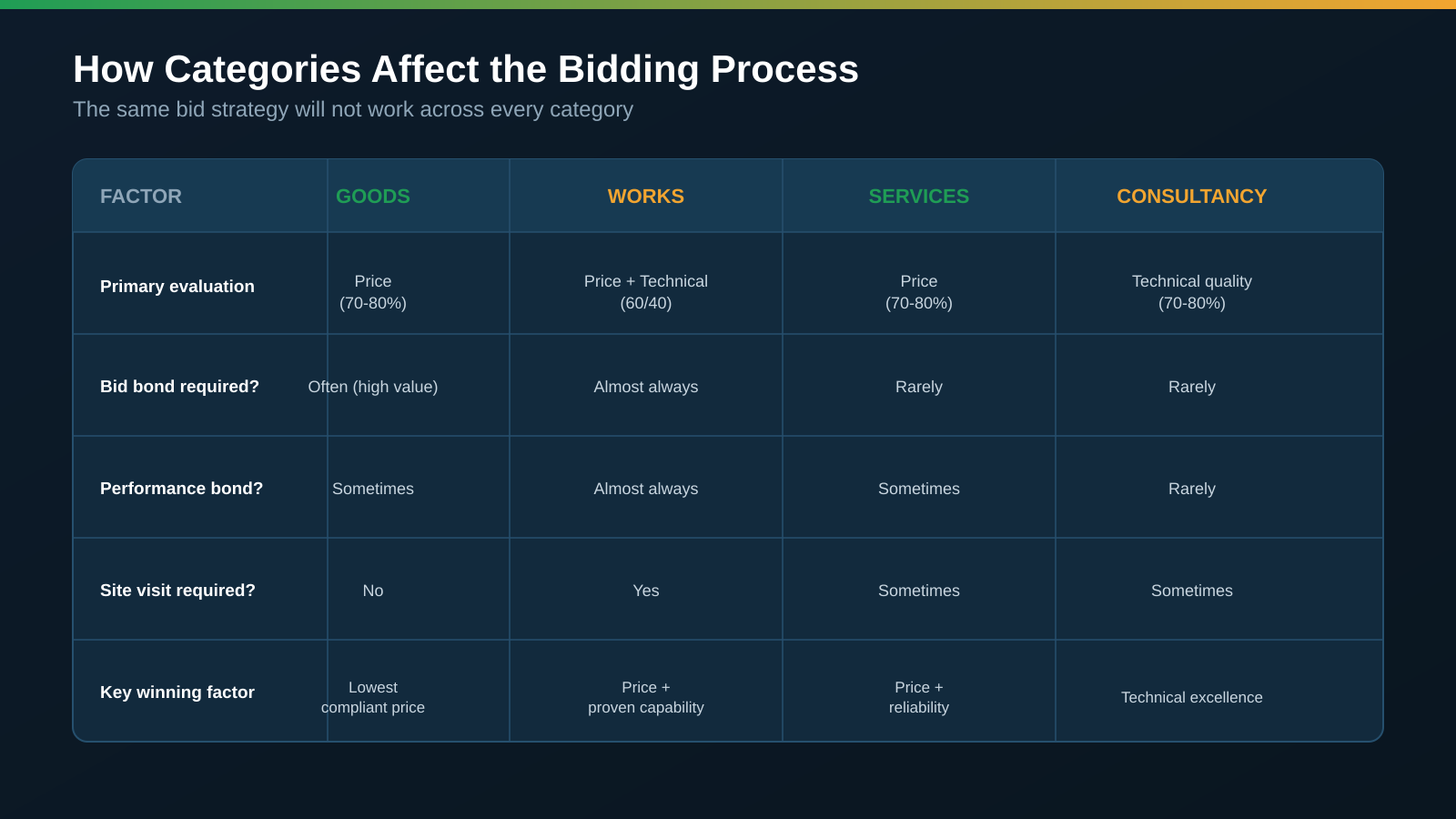
Understanding this table is critical. A construction firm bidding on a works tender cannot win on price alone — they need to demonstrate technical competence, equipment, and experience. Conversely, a consultancy firm cannot win with a cheap proposal if their technical score is below the threshold.
Special Procurement Methods by Category
Beyond the four main categories, ZPPA allows different procurement methods depending on the value and complexity:
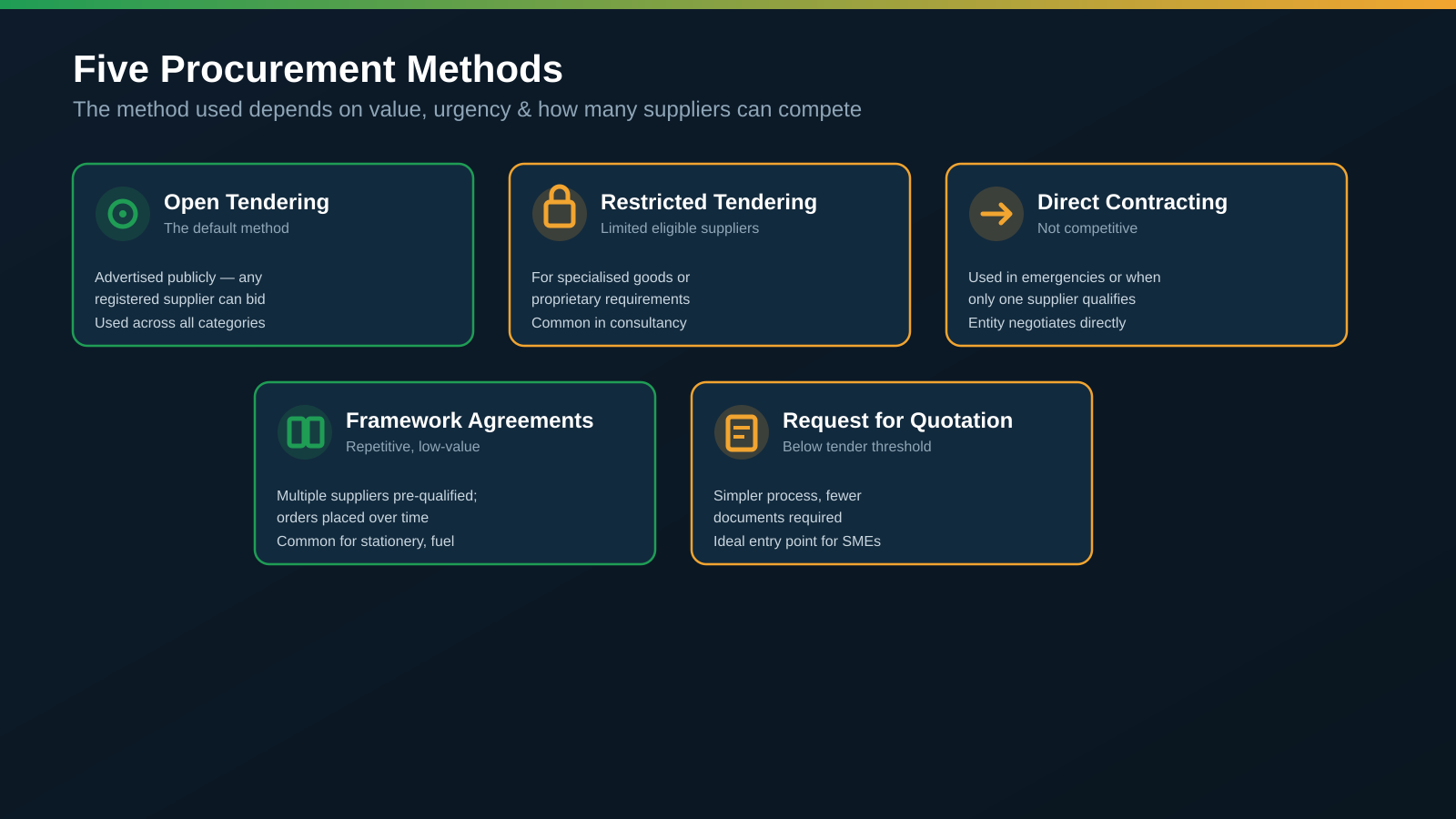
- Open Tendering: The default method. Advertised publicly. Any registered supplier can bid. Used for all categories when value exceeds the threshold.
- Restricted Tendering: Used when only a limited number of suppliers are capable (e.g., specialised medical equipment, proprietary software). Common in consultancy and complex goods.
- Direct Contracting: Used in emergencies or when only one supplier can provide the required product or service. Not competitive — the procuring entity negotiates directly.
- Framework Agreements: Used for repetitive, low-value purchases. Multiple suppliers are pre-qualified, and individual orders are placed against the framework over time. Common for stationery, fuel, and routine services.
- Request for Quotation (RFQ): For purchases below the tender threshold. Simpler process, fewer documents. Ideal for SMEs entering the government market.
How to Choose the Right Category When Registering
When you register on e-GP, you must select which categories you want to bid in. Here is how to decide:
Align with your PACRA business objectives. Your certificate of incorporation states what your company is authorised to do. If it says “trading in general goods,” bidding in “Works” will be difficult to justify.
Do not overreach. Bidding in a category where you have no experience wastes your time and money. Worse, if you win and cannot deliver, you face blacklisting and legal action.
You can register in multiple categories — but you need evidence for each. A company that supplies office furniture (Goods) and also provides office cleaning (Services) can register in both, provided they have the staff and references to support each.
Start with one category, then expand. If you are new to government bidding, register in the category where you are strongest. Win a few contracts, build a track record, then add categories.
Conclusion
Tender categories are not just administrative labels. They determine how your bid is evaluated, what documents you need, and what it takes to win. The suppliers who understand these categories — and bid strategically within them — are the ones who build sustainable government contracting businesses.
Before you register on e-GP, before you download a single tender notice, ask yourself: “Which category am I actually qualified to win in?” Answer that honestly, and your bidding success rate will improve immediately.
Find tenders in your category today. Browse running tenders and filter by Goods, Works, Services, or Consultancy to see only the opportunities relevant to your business.
Related articles: How to Register as a Supplier on Zambia’s e-GP Platform