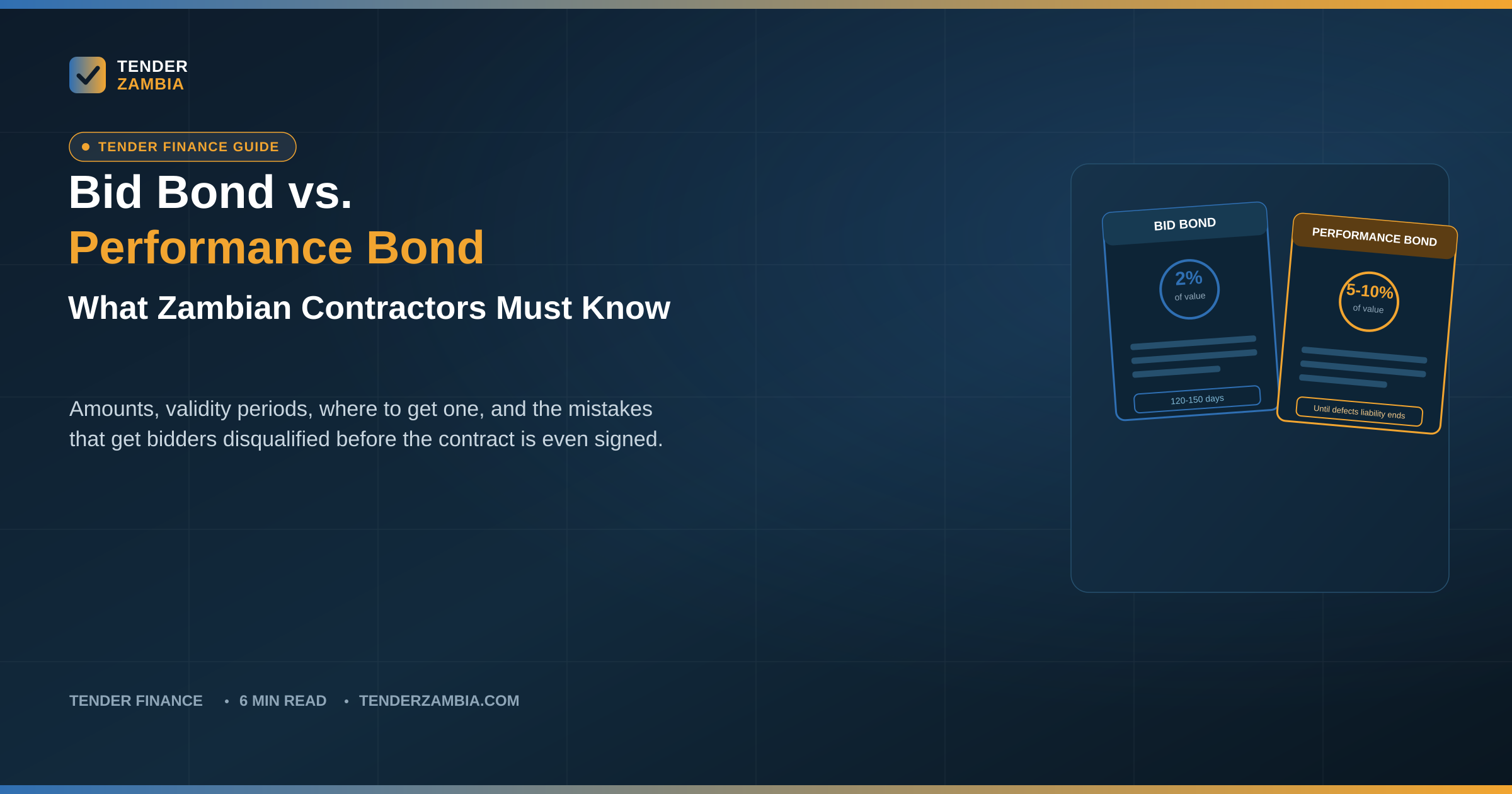
Bid Bond vs. Performance Bond: What Zambian Contractors Must Know

Introduction

You submitted your bid. The evaluation committee liked your proposal. You are about to be awarded the contract — but then you are asked for a performance bond, and you realise you do not understand what that means or how to get one.

This scenario plays out repeatedly in Zambia. Bonds are a standard requirement in public procurement, yet many bidders treat them as an afterthought. The result? Disqualification, delayed contract signing, or worse — financial penalties that cripple a small business.

This article explains the two bonds you will encounter most often in Zambian tenders: the bid bond and the performance bond. You will learn what they are, how much they cost, where to get them, and the costly mistakes to avoid.

What Is a Bid Bond?

A bid bond is a financial guarantee that you submit with your tender bid. It is not optional — if the tender notice requires a bid bond and you do not provide one, your bid is disqualified immediately.

Purpose: The bid bond guarantees that if you are awarded the contract, you will sign it and provide the required performance bond. If you win and then withdraw, the procuring entity can claim the bid bond amount as compensation for the time and cost of re-tendering.

Typical amount: Usually 2 percent of the estimated contract value. For a K10 million contract, the bid bond would be K200,000.

Validity period: Usually 120 to 150 days from the date of bid opening. The bond must remain valid until the contract is awarded. If the evaluation process takes longer than expected and your bond expires, you must renew it or risk disqualification.

Format: The bond must be issued by a recognised Zambian bank or insurance company. It is typically a bank guarantee or an insurance bond. Cash deposits are rarely accepted in public procurement.

Refund: If you are not awarded the contract, your bid bond is returned to you, usually within 14 to 30 days of contract award. If you win and sign the contract, the bid bond is either returned or converted into part of the performance bond.

What Is a Performance Bond?

A performance bond is a guarantee you submit after winning the tender, but before signing the contract. It is your promise that you will complete the work as specified.

Purpose: If you fail to deliver — whether by abandoning the project, delivering substandard work, or missing deadlines — the procuring entity can claim the performance bond to cover the cost of hiring another contractor to finish the job.

Typical amount: Usually 5 to 10 percent of the contract value. For a K10 million contract, the performance bond would be K500,000 to K1,000,000.

Validity period: Until the project is completed and the defects liability period has ended. The defects liability period is typically 6 to 12 months after project handover, during which you are responsible for fixing any defects.

Format: Same as bid bonds — issued by a recognised bank or insurer.

Refund: Returned after the defects liability period expires and the procuring entity confirms satisfactory completion.

Comparison of bid bond and performance bond: when required, purpose, typical amount, validity period, refund conditions, and penalty for default

Where to Get Bonds in Zambia

You cannot get a bond from any bank. ZPPA and most procuring entities require bonds from recognised financial institutions.What your bank or insurer will ask for when issuing a bond, plus a list of recognised banks and insurance companies in Zambia

Major banks: Zanaco, Stanbic Bank Zambia, Absa Bank Zambia, FNB Zambia, Standard Chartered Zambia, and other Bank of Zambia-licensed institutions.

Insurance companies: Madison General Insurance, Prudential Zambia, and other registered insurers.

What the bank or insurer needs from you:

  • The tender notice or award letter
  • Your company’s audited financial statements (last 2–3 years)
  • Bank statements showing cash flow
  • Your PACRA certificate and tax clearance
  • Proof of past contract performance (for large bonds)

Processing time: Typically 3 to 7 business days, but allow 10 days to be safe. Do not wait until the day before submission.

Cost: Banks and insurers charge a fee — usually 1 to 2 percent of the bond value per annum. For a K200,000 bid bond, expect to pay K2,000 to K4,000. This is a business cost, not a deposit — you do not get it back.

Common Bond Mistakes That Cost Contracts

1. Submitting a Bond from an Unapproved Institution. Some bidders use small microfinance institutions or foreign banks that ZPPA does not recognise. If the tender notice specifies “recognised Zambian bank,” and your bond is from an unlisted institution, you are disqualified.

2. Incorrect Bond Amount. The tender notice specifies the exact percentage. If it says 2 percent and you submit 1.5 percent, you are non-compliant. Calculate carefully and confirm with your bank.

3. Bond Expires Before the Validity Period. If your bid bond is valid for 90 days but the tender requires 150 days, and the evaluation takes 120 days, your bond will expire mid-process. The procuring entity will ask you to renew it. If you cannot, you are disqualified.

4. Not Converting Bid Bond to Performance Bond Quickly. After winning, you typically have 14 to 30 days to submit the performance bond and sign the contract. If you delay, the procuring entity may award to the next-ranked bidder.

5. Forgetting to Claim Refunds. Many unsuccessful bidders forget to reclaim their bid bonds. Set a reminder to follow up with your bank 30 days after the contract award date.

What Happens If You Default?

Defaulting on a bond is serious:Five consequences of defaulting on a bond: the bank pays the procuring entity, you owe the bank plus interest, ZPPA may blacklist you, possible legal action, and reputational damage

The message is simple: only bid on contracts you are capable of delivering. A bond is not a formality — it is a real financial commitment.

Conclusion

Bonds protect both the procuring entity and the integrity of the procurement process. For bidders, they are a cost of doing business with government. The key is to understand the requirements before you bid, choose a recognised bank, and ensure your bond covers the full validity period.

Never treat bonds as an afterthought. They are one of the most common reasons for disqualification — and one of the easiest to get right.

Check the bond requirements before you bid. Browse current tenders on Tender Zambia and see exactly what each tender demands.

Questions about a specific tender’s financial requirements? Contact us via WhatsApp and our team will guide you.


Related article: How to Prepare a Winning Tender Document in Zambia