Introduction
The difference between a winning bid and a rejected one often comes down to one thing: document preparation. In Zambia’s competitive procurement environment, many capable companies lose tenders not because they lack expertise, but because they failed to prepare their documents properly.
ZPPA and procuring entities are strict on compliance. A missing signature, an expired tax clearance, or an arithmetic error in your pricing can disqualify an otherwise excellent bid. Meanwhile, the company that followed a systematic preparation process — even if less experienced — walks away with the contract.
This guide is a practical, checklist-driven walkthrough of how to prepare a tender submission that is compliant, competitive, and compelling.

Step 1: Read the Tender Document Thoroughly
This sounds obvious, but it is the most violated rule in tendering. Do not skim. Read every page, including appendices, forms, and clarifications.
What to highlight:
- Eligibility criteria (who can bid)
- Mandatory requirements (documents you must submit)
- Evaluation criteria (how you will be scored)
- Submission format (page limits, font size, binding, number of copies)
- Deadline date and time (including the exact location or portal for submission)
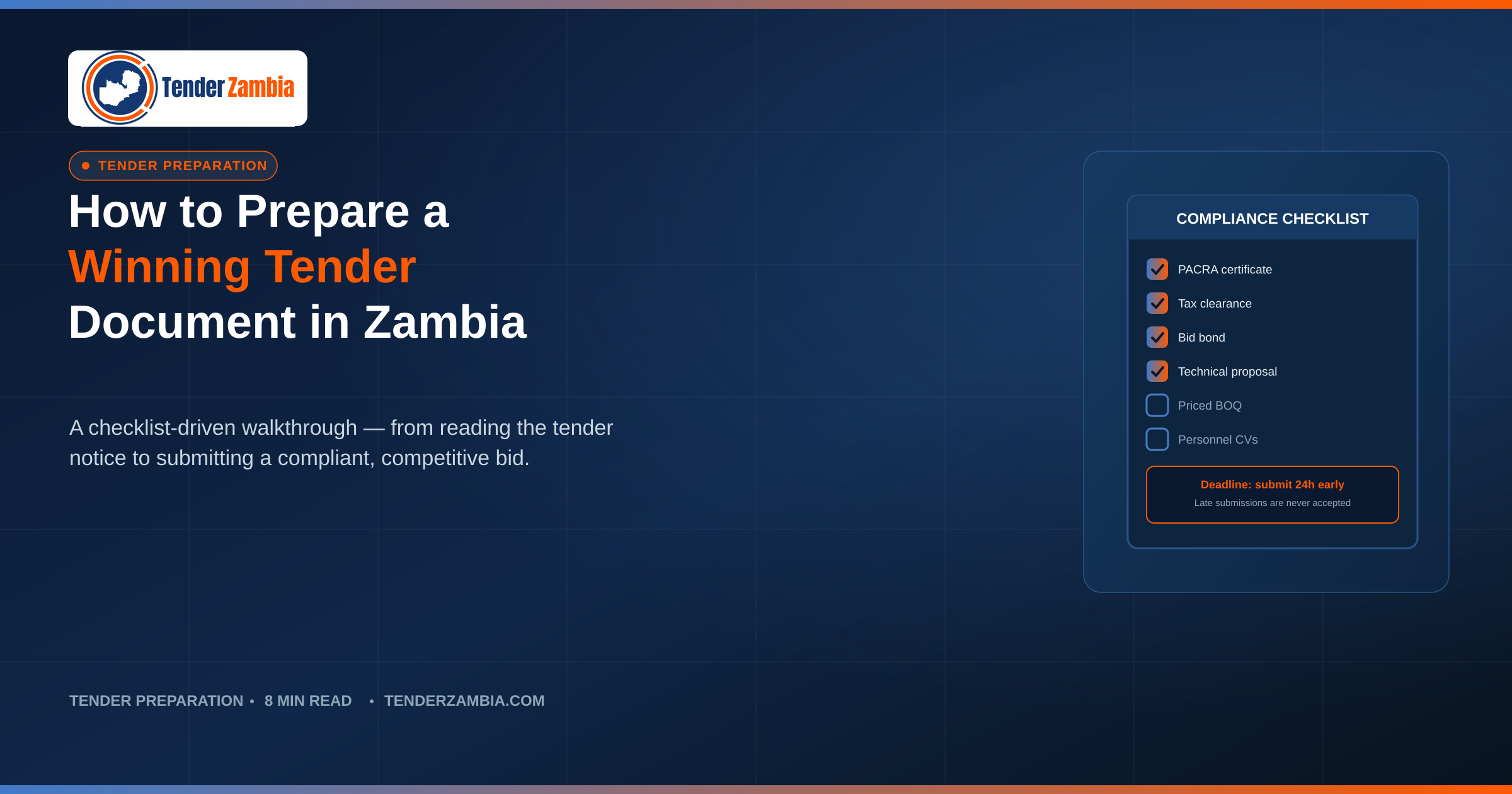
Create a compliance checklist. Go through the tender document line by line and create a checklist of every requirement. This becomes your preparation roadmap.
Understand the language: In tender documents, “shall” means mandatory. “Should” means recommended but not strictly required. If the document says “the bidder shall submit a bid bond,” you must submit one. If it says “the bidder should include a company brochure,” it is optional but advisable.
Step 2: Gather Your Mandatory Documents
Before you write a single page of your proposal, collect every document the tender requires. Missing one document means automatic disqualification.

Company documents: PACRA certificate of incorporation (current), tax clearance certificate from ZRA (current), TPIN certificate, and e-GP supplier registration proof.
Financial documents: Audited financial statements for the last 2 to 3 years, recent bank statements (usually last 3 to 6 months), and a bank guarantee or bid bond (if required).
Technical documents: Method statement (how you will do the work), work plan with timelines (Gantt chart recommended for works and consultancy), equipment list (for works and services), personnel CVs and organisational chart, and a quality assurance plan.
Experience documents: Reference letters from past clients, completion certificates from previous contracts, photographs of completed projects (for works), and past contract summaries (value, scope, client, completion date).
Pro tip: Maintain a “tender readiness folder” that you update monthly. When a tender drops, you should be able to pull 80 percent of your documents immediately, rather than scrambling for a tax clearance that expired last week.
Step 3: Structure Your Technical Proposal
Your technical proposal is where you prove you can deliver. Structure it clearly and address every requirement in the tender’s Terms of Reference.
Executive Summary (1 page maximum): Who you are, why you are qualified, what you will deliver, and how you will deliver it. Keep it concise — evaluators read dozens of proposals.
Understanding of the Requirements: Demonstrate that you read and understood the scope. Do not copy-paste the tender document — paraphrase and add your interpretation. Show that you understand the client’s problem, not just the deliverables.
Methodology / Work Plan: A step-by-step approach with realistic timelines and milestones, plus resource allocation (who does what, when). For works, include a Gantt chart. For consultancy, include a detailed work plan with deliverables and review points.
Personnel: CVs of key staff (limit to the number specified in the tender), an organisational chart showing reporting lines, a roles and responsibilities matrix, and availability confirmation — make sure proposed staff are actually available.
Equipment and Resources: What you own, what you will hire or subcontract, why your resources are sufficient, and maintenance plans for equipment.
Quality Assurance: How you will ensure standards are met, your inspection and testing procedures, and third-party verification if applicable.
Risk Management: Identify 3 to 5 key risks (e.g., weather delays, supply chain issues, currency fluctuation), a mitigation strategy for each, and contingency plans.
Step 4: Price Your Bid Competitively
Pricing is where many bidders go wrong. You need to be competitive, but you also need to be sustainable.

Understand the evaluation weighting. If the tender is 70 percent price and 30 percent technical, price matters enormously. If it is 80 percent technical and 20 percent price (consultancy), focus on quality and price reasonably.
Do not underprice. Unsustainably low pricing raises red flags — evaluators may suspect you do not understand the scope or plan to cut corners. If you win at a loss, you damage your business.
Include all costs: direct costs (materials, labour, transport, equipment), indirect costs (overhead, administration, insurance, bonds), profit margin (typically 10 to 20 percent depending on risk), and taxes (include VAT if applicable).
Use the BOQ format exactly. If the tender provides a Bill of Quantities, fill it out precisely. Do not alter quantities or add extra columns unless permitted. Double-check your arithmetic — errors in the BOQ are common disqualifiers.
Step 5: Review, Format, and Package
A brilliant proposal that is poorly formatted creates a bad impression. Presentation matters.
Follow the submission format exactly: page limits (if the tender says “maximum 50 pages,” submit 50 or fewer), font size and type (usually specified, e.g. Times New Roman, 12pt), binding (spiral, comb, or hardbound as required), and the exact number of copies requested.
Use clear headings and a table of contents. Evaluators should find any section within seconds. Number your pages and label every appendix clearly.
Proofread for grammar and spelling. A proposal full of typos looks unprofessional. Have a second person review it, and read it aloud — you will catch awkward phrasing.
Package securely: use a professional envelope or box, seal properly, and label clearly with the tender title, tender number, and “DO NOT OPEN BEFORE [DATE].” For electronic submission, ensure file formats match requirements (usually PDF).
Step 6: Submit On Time
Late submissions are never accepted in Zambian public procurement. Never.
Submit at least 24 hours before the deadline. This gives you a buffer for traffic, technical issues, or last-minute document corrections. For e-GP submissions, upload early — portal slowdowns are common on deadline day.
Get a receipt or acknowledgement. For physical submissions, get a stamped receipt. For e-GP, take a screenshot of the submission confirmation.
Keep a complete copy of everything you submitted. You will need this if there is a dispute or clarification request.
Conclusion
Tender preparation is not about being the cheapest or the biggest company. It is about being the most prepared. The suppliers who win consistently are the ones who treat every tender submission as a project in itself — with a timeline, a checklist, and a review process.
Follow these six steps, and you will move from “participant” to “competitor.”
Find tenders worth your preparation time. Browse the latest opportunities on Tender Zambia and filter by your industry, location, and deadline.
Get deadline reminders before it’s too late. Subscribe to Tender Zambia’s alert service and receive notifications straight to your inbox or WhatsApp.
Related reading: Bid Bond vs. Performance Bond: What Zambian Contractors Must Know