Introduction
The rules of public procurement in Zambia are evolving. The Public Procurement Act No. 8 of 2020, administered by the Zambia Public Procurement Authority (ZPPA), established the framework for how government buys goods, services, works, and consultancy. But an Act is not the whole picture — amendments and statutory instruments issued since 2020 have materially changed how tenders are bid on, evaluated, and appealed.
For bidders, staying current is not optional. Missing a regulatory change can mean missing an appeal deadline that’s now half as long as it used to be, or misunderstanding who actually qualifies for preferential treatment on a tender you’re counting on.
This article walks through what has actually changed — and what’s still the same — so you’re working from the current rules, not outdated assumptions.
The Legal Framework at a Glance

The Public Procurement Act No. 8 of 2020 repealed and replaced the 2008 Act and became operational in April 2021. It applies to all public funds — central government ministries, local authorities, parastatals, and any entity spending public money. ZPPA is the sole regulatory authority: it sets regulations, monitors compliance, runs the e-GP platform, and is the only body mandated to suspend or debar bidders and suppliers.
Since then, two developments have changed how the Act works in practice:
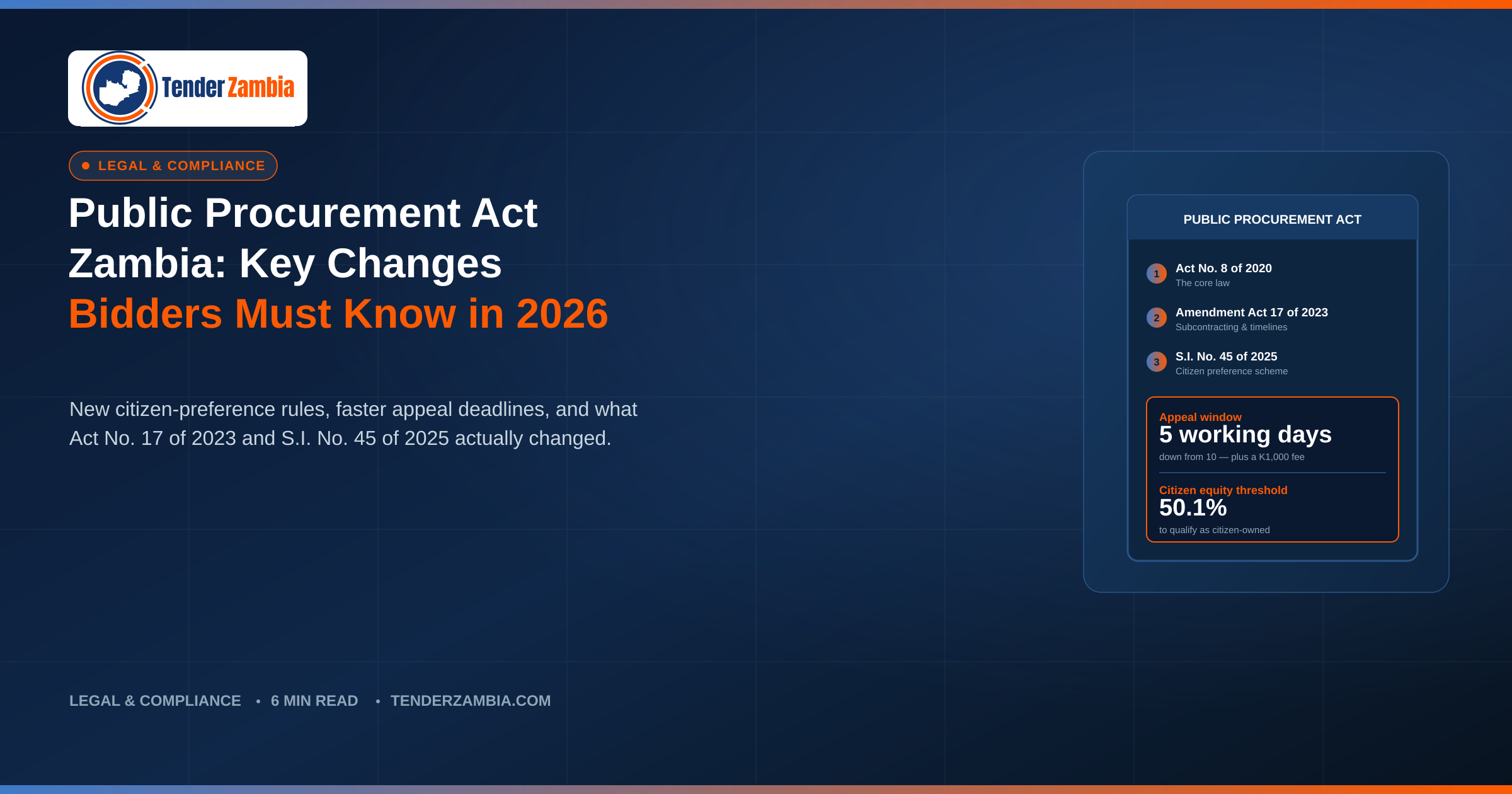
The Public Procurement (Amendment) Act No. 17 of 2023, which commenced on 22 December 2023, revised the period for conducting a procurement process, restricted subcontracting to procurement of works, and extended subcontracting rights to local bidders.
The Public Procurement (Preference and Reservation Schemes) Regulations, Statutory Instrument No. 45 of 2025, signed on 25 June 2025 — the most significant change for bidders this year, covered in detail below.
The Big Change: The 2025 Citizen Preference Scheme
S.I. No. 45 of 2025 institutionalises preferential treatment for citizen-owned firms, along with women, youth, persons with disabilities, and small businesses, in public procurement.

What “citizen-owned” actually means: a company where at least 50.1 percent of its equity is owned by Zambian citizens, where citizens have significant, demonstrable control over management — not just equity on paper — and which is licensed to do business in Zambia.
What changed in practice: procurements conducted under Open National Bidding and Open National Selection are now restricted to citizen and local bidders, with citizen bidders receiving priority during bid evaluation, per Section 39(2) of the Amendment Act No. 17 of 2023. If you’re a local bidder that doesn’t meet the citizen-owned threshold, you’ll need to partner with a citizen bidder to compete for these reserved tenders — and foreign bidders participating in open international bidding must also partner with a citizen supplier or bidder.
What this means for you: if your company is majority citizen-owned, this is a real, current advantage — make sure your PACRA shareholding documentation clearly demonstrates it. If it isn’t, start identifying potential citizen-bidder partners now, before you need one for a specific tender. Procuring entities are required to submit quarterly reports on how they’ve applied these schemes, so ZPPA is actively tracking compliance on the buyer side too.
Appeals Just Got Faster
If you believe you were unfairly disqualified or that an evaluation was flawed, you have the right to appeal — but the window to act has tightened considerably.

ZPPA revised the appeals procedure to align with the Amendment Act No. 17 of 2023: the timeline for lodging an appeal or investigation was cut from 10 working days to 5 working days. That clock starts from the date you were informed of the circumstances giving rise to your complaint — or the date you should reasonably have known, whichever is earlier. This supersedes the previous ZPPA Circular No. 13 of 2022.
An application for review or appeal to ZPPA must be accompanied by a non-refundable fee of K1,000, in accordance with Section 100(1)–(3) of the Act and the applicable Regulation.
On the procuring entity’s side: a controlling officer or chief executive officer must submit a written decision to ZPPA within 5 working days of receiving a complaint, after which ZPPA has a further 5 working days to decide the matter or schedule a hearing.
What this means for you: if you think you have grounds for a complaint, do not wait. Half the previous window means you need to have your evidence and paperwork ready to file almost immediately after a decision you intend to challenge.
Subcontracting Rules Were Tightened
The 2023 Amendment Act specifically restricted subcontracting to the procurement of works — it is no longer treated as a general-purpose mechanism across all categories — while at the same time extending subcontracting opportunities to local bidders. If subcontracting is part of your bidding or partnership strategy, confirm which category your tender falls under before assuming the same subcontracting terms apply as before 2023.
Suspension and Debarment: The Stakes Remain High
ZPPA maintains a register of bidders and suppliers who are suspended or debarred from public procurement, and it remains the only authority permitted to take that action. Specific grounds for suspension are set out in the Act, a bidder facing suspension has the right to appeal that decision, and a permanent bar remains available for the most serious violations. Because the exact suspension periods that apply under the current Act can be updated by regulation, always check the current position directly with ZPPA rather than relying on a fixed number — the risk of guessing wrong here is a multi-year loss of access to public contracting.
The underlying message hasn’t changed: collusion, bribery, and falsified documentation are not worth the risk. A blacklisting is public, and it follows your company.
The e-GP Push Continues
ZPPA has been actively integrating the e-GP platform with IFMIS, PACRA, and ZRA systems, with ongoing supplier training on these integrations. Practically, this means your PACRA and ZRA compliance records may increasingly be checked or cross-referenced automatically through the platform — another reason to keep your tax clearance, TPIN, and company records current at all times, not just when a tender deadline is approaching.
How These Changes Affect Your Bidding Strategy
1. Check your citizen-ownership status and document it properly. If you qualify, make sure it’s clearly demonstrable in your PACRA records. If you don’t, start building relationships with potential citizen-bidder partners now.
2. Treat the appeal window as 5 working days, not 10. Build a standing template for complaints so you can file quickly if you ever need to.
3. Confirm subcontracting terms against the current rules before structuring a bid around subcontracting outside of works.
4. Keep compliance records current year-round, not just at bid time, given the tightening e-GP/PACRA/ZRA integration.
5. Never treat compliance as optional. One suspension or debarment can end your access to public contracting for years.
Where to Find Official Updates
- ZPPA website: zppa.org.zm — the primary source for the Act, regulations, and circulars
- ZambiaLII: zambialii.org — consolidated, up-to-date legislation text
- Tender Zambia blog: we track procurement changes so you do not have to
Conclusion
The Public Procurement Act and its supporting regulations are designed to protect both the public purse and the rights of bidders. The two most consequential recent changes — the citizen preference scheme and the shortened appeal window — reward bidders who stay current and penalise those working from outdated assumptions.
The suppliers who thrive in 2026 and beyond will be the ones who treat regulatory change as part of their bidding strategy, not an afterthought.
Stay updated on every tender that matters. Browse current opportunities on Tender Zambia and never miss a bidding window.
We track procurement changes so you do not have to. Subscribe to Tender Zambia for regulatory updates and tender alerts.
Related reading: How to Register as a Supplier on Zambia’s e-GP Platform